Showing posts with label games. Show all posts
I am back with new ideas and new materials.
Let me show you my version of the game "I have who has". The rules are the same, but I made a few changes. Instead of the phrase "I have" I used the phrase "I am" and the name of a profession. I also replaced the question "who has" with the question word "who" and the definition of the profession. 
Have fun :-)

Designed by Freepik
I love flashcards! I use them with both young learners and teenagers. That's why I've recently bought a new set of flashcards with all the vocabulary from "Bugs Team 1" by Macmillan. The set contains 110 full-colour cards printed on thick paper (the flashcard sets for the previous editions of "Bugs" that I own are printed on even thicker paper). The thickness is very important - it makes flashcards durable. That's why when I make my own flashcards, I print them on plain paper and laminate them.

Why do I need flashcards? I love to play with them in the classroom. They are perfect to revise vocabulary and to practice speaking. Do you want to know my TOP 5 flashcard games and activities for young learners?

GAME No 5 - MEMORY

Everyone knows Memory. In the 1st grade I usually use pairs of matching pictures, and with older students I use picture - word pairs (up to 12 cards). Randomly selected student points at two cards I should turn over to find a pair. Each flashcard is identified by a letter and a number so that everyone knows what cards were chosen. If the two cards match, they stay uncovered. If they don't match, I turn them back over. I always ask my students to name the pictures in English, when I turn the cards over. The game is finished when all the cards have been matched.


GAME No 4 - TIC TAC TOE

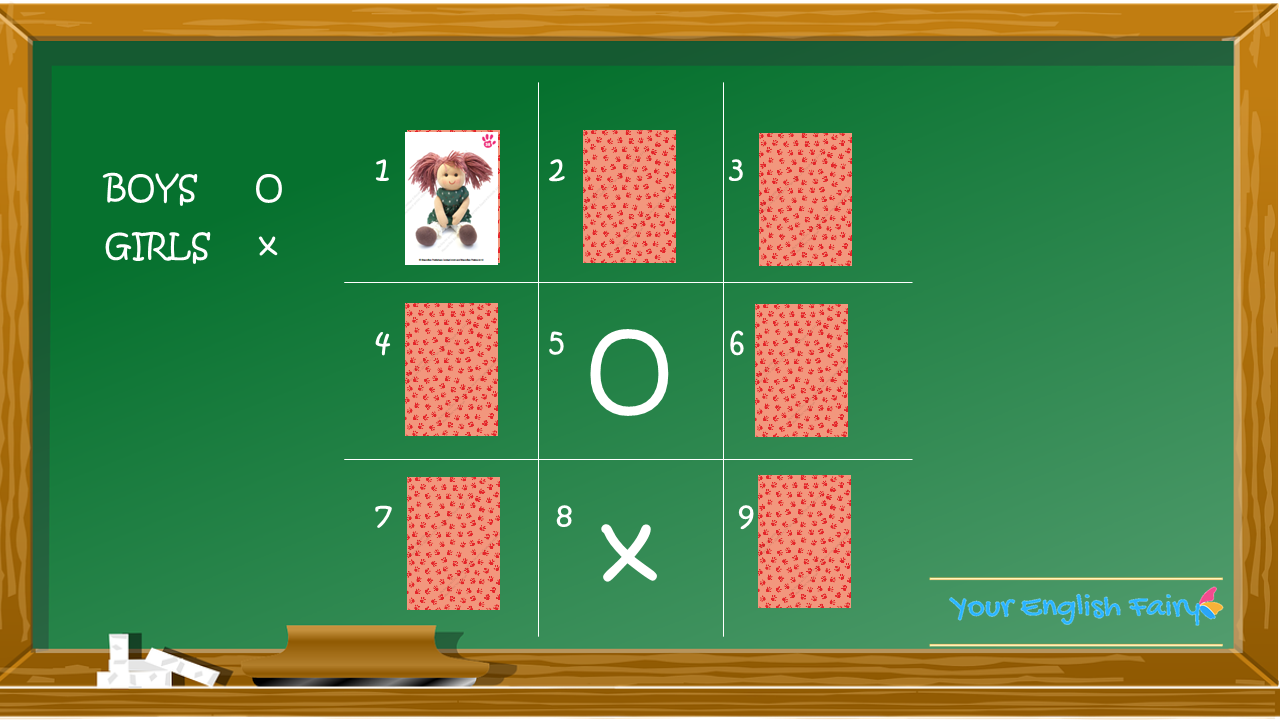
You know it as a paper-and-pencil game but I use my blackboard and flashcards to play it. I divide a class into two groups, usually girls and boys (X and O). I put nine flashcards on the board (face down) and number the spaces. In order to mark a space with their symbol, the students have to choose a space and say its number in English. Then I turn the card from the chosen space over and they have to name the picture in English. If they do it correctly, I remove the card and draw their symbol in the space. The first team to place three of their marks in a horizontal, vertical, or diagonal row wins the game.


GAME No 3 - PICTURE GO!

This game doesn't require a blackboard. It requires some space. What do you need to do? Give each student a check list with words and ask them to write the numbers in the boxes in a random order. Hang the matching flashcards around the classroom. Then tell the students to go quietly eg. to number 5. They have to find the number on their list, quietly read the word and go to the card that matches the word. In this way there will be groups of students standing under each flashcard. Ask one student from each group to name the picture on the card in English. Then tell them to go to another number.

Designed by Freepik

GAME No 2 - DISSAPEARING CATS

This activity is taken from "Oxford Basics for Children - Starting and Ending Lessons". I draw two cats on the board (or any other creatures or things). One cat belongs to my students, one belongs to me. I usually revise six words with my students, showing them flashcards. Then I shuffle the flashcards and pick one without children to see it. They have to guess which picture I have chosen. If they are correct, I rub out a part of my cat. If they are wrong, I rub out part of their cat. I make the rubbing part very dramatic, eg. "Oh no! My cat lost his eye! He's a pirate now." It usually makes children laugh. They are also very happy, when my cat dissapears first.


GAME No 1 - THE FLY

It's definitely my favourite flashcard game! It's an activity for the whole class or for pairs/small groups. At the beginning, I write directions on the board (up, down, left, right). If we play it for the first time, I have to pre-teach them the words. Then I pin a flashcard with a fly on the board and eight flashcards around it. I choose one of the students to give directions for the fly, eg. "The fly is going up. The fly is going left. The fly is going left.". When they finish, they ask the question: "Where is the fly?" and choose another student to answer it. If the answer is correct, the next student guides the fly.


* BONUS GAME - PICTURE MATHS

When I revise vocabulary with young learners, I often use basic arithmetic operations (such as adding, subtracting, multiplying, and dividing numbers). I pre-teach words like: plus, minus, times and divided by. I put 6 flashcards on the board and I number them 1-6. Then I ask, e.g. "What is 2 + 2?". My students calculate it quietly and instead of saying the right number they have to tell me what is in the picture. So their answer is "mouse" not "4".


What are your favourite flashcard games? Can you share them in the commnets? Do you like my ideas?


Learning irregular verbs can be difficult. Today two of my 5th-graders: Amelia and Wiktoria prepared four exercises in learningapps to make it easier.


Practice makes perfect!
Describing wild animals can be fun, but kids can have more fun while describing strange animals. It's even better when it's a game.
All you need is a dice, crayons and a piece of paper.


Yesterday I divided my 3rd-graders into pairs. Each pair got one dice. Each student had to roll twice. They roll an animal on the first roll and a body part on the second roll. Then they drew what they'd rolled.


At first they didn't get it, as it was quite an unusual exercise. But then they created amazing animals and even described them in English.
It's Christmas time. Today I had my last lessons before Christmas break. I've prepared a surprise for my younger learners. I've made a large picture sudoku board (60 cm x 60 cm) to teach them Christmas vocabulary (Santa, reindeer, present, sledge).

At first we did the puzzle together, so they could get an idea what sudoku is. Then I devided them into small groups of three and they solved more advanced puzzles with the same pictures.
Here's a printable that you can use with your students.

Revision, revision, revision...
Young learners need variety of games and exercises to revise and consolidate vocabulary. Last week I played Spot it! with my 6- and 7-year-olds. At first I had some doubts about using this game in the classroom with very young learners. Fortunately, it worked perfectly!
I've prepared 4 sets of cards. Each set consisted of 13 cards with 4 different pictures.


I divided class into groups, 5-6 students per group. Each group was given one set of cards. Each student in a group took one card, the rest were placed face-down in a pile. Then one player took the first card from the pile and place it with their card on the floor. As soon as they found the match, they had to call it out in English. If the answer was correct they took both cards. If not, the card was placed under the pile. The winner was the player with the most cards.


Are your students bored with reading comprehension? You can make this activity more engaging if you "hide" the questions in the classroom. This way students have to move around to find them. I always tell the students to read the text first and then to go seeking.


When I revise vocabulary with very young students, I often use basic arithmetic operations (such as adding, subtracting, multiplying, and dividing numbers). I pre-teach words like: plus, minus, times and divided by. I put 6 flashcards on the board and I number them 1-6. Then I ask, e.g. "What is 2 + 2?". My students calculate it quietly and instead of saying the right number they have to tell me what is in the picture. So their answer is "crayons" not "4".


Sitting at the desk for 45 minutes can be really tedious for students. My teacher in secondary school had this saying: "Move your 'bottom' and your mind will follow". Last Thrusday I decided to try running dictation with my 5th-graders. Most of them were very enthusiastic about this exercise. 
I have to admit that I was enthusiastic, too. Running dictation combines: reading, speaking, listening and writing. It also develops vocabulary and grammar skills.

How did I do it?
  1. I divided my students into two groups. I asked them to stand in two lines.
  2. The first person in each group was the runner and the second person was the writer.
  3.  I put two copies of a short text on the wall opposite two desks.
  4. The runners in each group had to run to the wall, read the first sentence of the text, run back to the writers and quietly dictate what they remembered. Then they went to the end of the line.
  5. When the writer wrote down the sentence, they became the runner and the next person in the line became the writer. 
  6. When both teams were ready with the text, I swap their worksheets. They had to check them for mistakes.


We had so much fun with this activity. Next time we will try to do it in smaller groups or we will do it in the hall, so they will have to run.
For me it's time to begin another summer holidays. Last week my students asked me to prepare a lesson with smartphones. It wasn't easy, as the Internet connection in my classroom is very poor (Wi-Fi doesn't work). Yet we tried really hard to make this lesson happened. Some of my students were familiar with QR codes, but for most of them it was something new. 
I've prepared four QR codes and printed them in four different colours. The students scaned the codes and solved the puzzles linked with them. Then they had to put the words in the right order to make a holiday sentence.
Here are my QR codes (in a random order). Have fun!
My students at work:


Coding and decoding can be a lot of fun. Especially, when it is in English. The weather is beautiful lately, so it is difficult to be productive in the classroom. I have to make my lessons more interesting than the spring weather. My idea is to use a secret alphabet code. You can easily find a lot of examples online and choose whichever you like. 
I like the pigpen cipher:


Yesterday I wrote 8 sentences (e.g. It's Saturday. We don't have to go to school.) and then I rendered them in ciphertext. I cut them into pieces (each sentence had its own colour). I scattered the pieces in the classroom, so the students could decipher them and put them in the right order to make sentences.


As you can see, my students were very focused (despite the weather). They even worked in pairs and groups willingly.
BTW, I've tried a new app: Pic Collage to create the photo collage above. It's my first attempt. I have an idea how I can use this app with my students.
Another wonderful year has just begun and here I am again with my blog entries! It's been a while since my last post. Sorry for that.
This school year I'm lucky to teach amazing 4th-graders. For those kids I would go the extra mile.
This week they learned about question words and wh- questions with the verb "to be" in Present Simple. Here are some online exercises:
(Use them in a full-screen mode.)

When I was a kid, I used to watch a lot of TV travel programmes with my dad. He knows a lot about nature and geography, so when I was young, he was my expert on this subject.
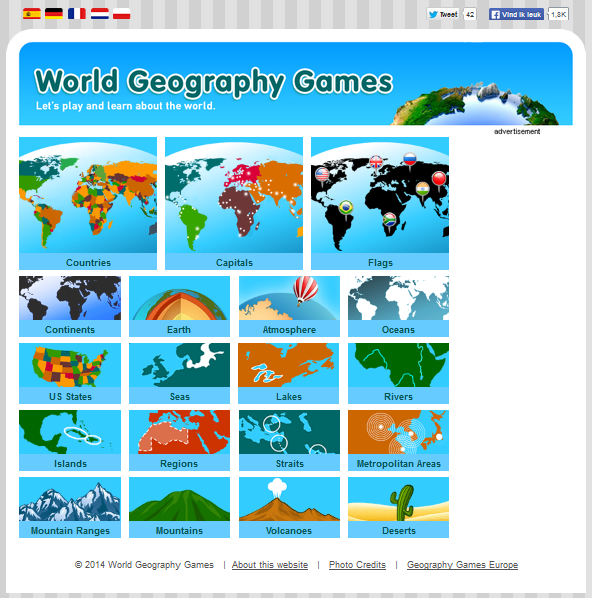
Recently, I've discovered a great website with geography games. There are a few games you can play and check your knowledge of countries, capitals, flags, rivers, etc.

http://world-geography-games.com/


I love teaching and I love ICT. But what I like the most is combining those two. I don't mind trying new apps or ICT tools. It's not a problem to learn how to use them.
Recently, I've created an account on LearningApps.org.There is a wide range of possibilites to make your own apps. It's very easy to use, as there are various templates. You can create apps on different levels of difficulty.
Here's a simple one:

I hope this won't be the last part of my Silly Sentences set.

Silly Sentences p8 by kakitis

Last but not least - prepositions. It's the last part of my set that contains words. And tomorrow's one will be with periods and and some extra vocabulary.

Silly Sentences p7 by kakitis

All but one verb in the 6th part of my Silly Sentences set are in the past form. I hope it's easier that way. If you want the verbs in the infinitive form, please let me know in the comments.

Silly Sentences p6 by kakitis

There are 24 nouns in the 5th part of my Silly Sentences set. If it's not enough, I'll prepare more. Just let me know in the comments.

Silly Sentences p5 by kakitis

The fourth part of my Silly Sentences set contains 24 adjectives.

Silly Sentences p4 by kakitis

Here's the third part of the set with definite and indefinite articles.

Silly Sentences p3 by kakitis