Showing posts with label young learners. Show all posts

I promised to tell you how I teach English to my little daughter. Well, teaching is a big word in this situation. I just try to speak Polish and English to my daughter as much as possible, so she could pick up both languages. As you know I read and tell her stories but lately she prefers songs. I'm not the best singer but my little baby doesn't mind for now. When it's time to sleep I sing her traditional Polish lullabies or calm songs in English. And when we change diapers or when we play she prefers more energetic songs. Our favourites are some songs from Super Simple Songs, such as "Baby Shark", "Five Little Ducks" and "The Ants Go Marching" - they are easy to sing and the lyrics are easy to remember. We have recently discovered a new one: "My Teddy Bear".


This song is so simple but it offers endless possibilities to use it for teaching English. A few days ago I came up with the idea to change the lyrics and sing it to my daughter after changing her diaper. Here's my version of the first verse (in fact, it could be the second or the third verse):


Then I change "blue eyes" to e.g. "small ears", "one nose" or "two hands" and so on. As you can see,  the order doesn't matter. I just sing about different body parts in each verse. And I use different adjectives or numbers. What is more important, I also use movement by pointing to particular body parts while singing. For example, when I'm singing: "My baby girl has small ears.", I gently touch her ears. And I always hug her when I'm sining: "I love my baby girl."
If you have a baby boy, it's very easy to change the lyrics ;)


And what about you? Do you have your favourite English songs? Do you sing them with your own lyrics?
http://www.thedotclub.org/dotday/
Do you know Vashti? She's an inspirational character in the book "The Dot" by Peter H. Reynolds. "The Dot" is a story of a little girl who doubted in her own abilities, but encouraged by her teacher she put a small dot on a piece of paper and discovered her potential. The story is so powerful that teachers around the globe share it with their students and celebrate creativity and courage on the International Dot Day (September 15th).
For the last two years I've celebrated this day with my school community. This year I will do it at home with my daughter :)
I have also a few ideas for the next school year. One of them is an art activitity - mixing colours. Last year my 1st-graders were given plates with some yellow, red and blue paints. They mixed colours on the paper using their fingers (wearing protective gloves). Then they drew the primary colours they used to make the secondary colours.


A few days ago I got a wonderful gift from Mamania publishing house - "The Dot" in Polish ("Kropka"). Polish teachers who are members of a group called Superbelfrzy Mini prepared a short booklet with ideas on how to celebrate the Dot Day. I can proudly said that my ideas are in the booklet too. The booklet is in Polish, so it will be useful for speakers of Polish.


You can download the booklet here: Przewodnik po Dniu Kropki
Designed by Freepik
I love flashcards! I use them with both young learners and teenagers. That's why I've recently bought a new set of flashcards with all the vocabulary from "Bugs Team 1" by Macmillan. The set contains 110 full-colour cards printed on thick paper (the flashcard sets for the previous editions of "Bugs" that I own are printed on even thicker paper). The thickness is very important - it makes flashcards durable. That's why when I make my own flashcards, I print them on plain paper and laminate them.

Why do I need flashcards? I love to play with them in the classroom. They are perfect to revise vocabulary and to practice speaking. Do you want to know my TOP 5 flashcard games and activities for young learners?

GAME No 5 - MEMORY

Everyone knows Memory. In the 1st grade I usually use pairs of matching pictures, and with older students I use picture - word pairs (up to 12 cards). Randomly selected student points at two cards I should turn over to find a pair. Each flashcard is identified by a letter and a number so that everyone knows what cards were chosen. If the two cards match, they stay uncovered. If they don't match, I turn them back over. I always ask my students to name the pictures in English, when I turn the cards over. The game is finished when all the cards have been matched.


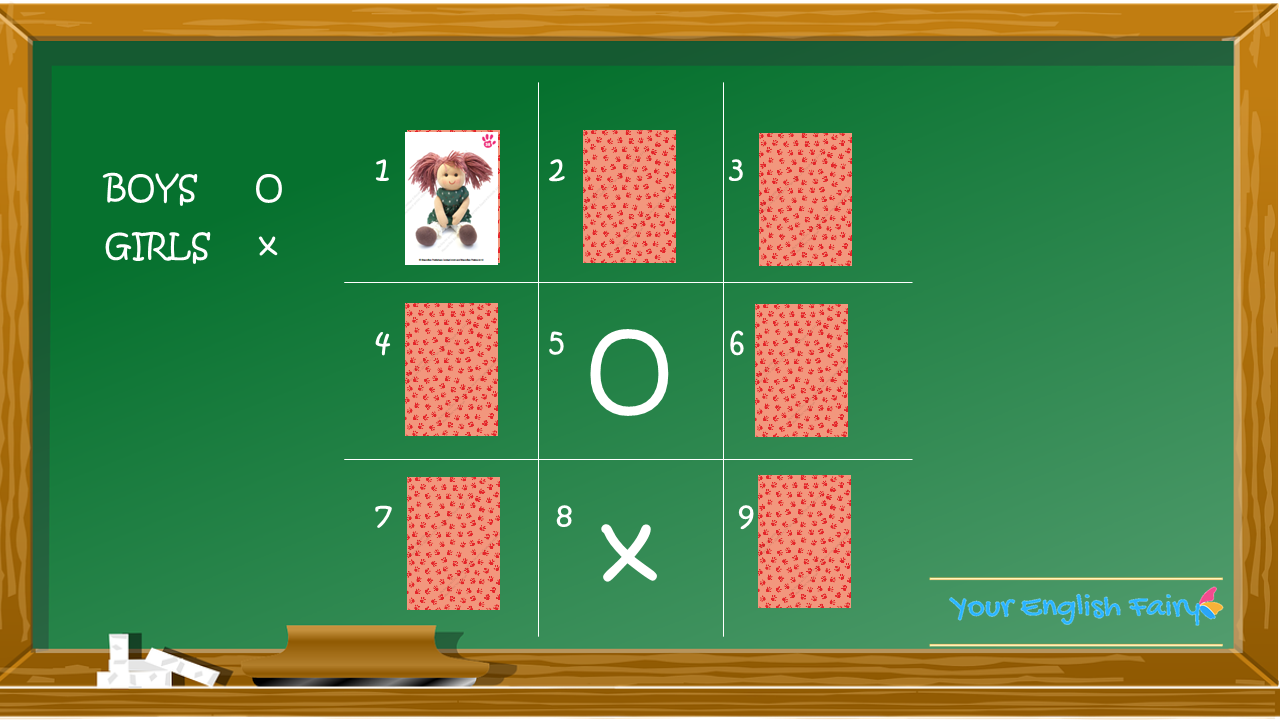
GAME No 4 - TIC TAC TOE

You know it as a paper-and-pencil game but I use my blackboard and flashcards to play it. I divide a class into two groups, usually girls and boys (X and O). I put nine flashcards on the board (face down) and number the spaces. In order to mark a space with their symbol, the students have to choose a space and say its number in English. Then I turn the card from the chosen space over and they have to name the picture in English. If they do it correctly, I remove the card and draw their symbol in the space. The first team to place three of their marks in a horizontal, vertical, or diagonal row wins the game.


GAME No 3 - PICTURE GO!

This game doesn't require a blackboard. It requires some space. What do you need to do? Give each student a check list with words and ask them to write the numbers in the boxes in a random order. Hang the matching flashcards around the classroom. Then tell the students to go quietly eg. to number 5. They have to find the number on their list, quietly read the word and go to the card that matches the word. In this way there will be groups of students standing under each flashcard. Ask one student from each group to name the picture on the card in English. Then tell them to go to another number.

Designed by Freepik

GAME No 2 - DISSAPEARING CATS

This activity is taken from "Oxford Basics for Children - Starting and Ending Lessons". I draw two cats on the board (or any other creatures or things). One cat belongs to my students, one belongs to me. I usually revise six words with my students, showing them flashcards. Then I shuffle the flashcards and pick one without children to see it. They have to guess which picture I have chosen. If they are correct, I rub out a part of my cat. If they are wrong, I rub out part of their cat. I make the rubbing part very dramatic, eg. "Oh no! My cat lost his eye! He's a pirate now." It usually makes children laugh. They are also very happy, when my cat dissapears first.


GAME No 1 - THE FLY

It's definitely my favourite flashcard game! It's an activity for the whole class or for pairs/small groups. At the beginning, I write directions on the board (up, down, left, right). If we play it for the first time, I have to pre-teach them the words. Then I pin a flashcard with a fly on the board and eight flashcards around it. I choose one of the students to give directions for the fly, eg. "The fly is going up. The fly is going left. The fly is going left.". When they finish, they ask the question: "Where is the fly?" and choose another student to answer it. If the answer is correct, the next student guides the fly.


* BONUS GAME - PICTURE MATHS

When I revise vocabulary with young learners, I often use basic arithmetic operations (such as adding, subtracting, multiplying, and dividing numbers). I pre-teach words like: plus, minus, times and divided by. I put 6 flashcards on the board and I number them 1-6. Then I ask, e.g. "What is 2 + 2?". My students calculate it quietly and instead of saying the right number they have to tell me what is in the picture. So their answer is "mouse" not "4".


What are your favourite flashcard games? Can you share them in the commnets? Do you like my ideas?

 
When I was pregnant I bought a book with seven fantastic stories. Every night me an my husband read a story to my belly. And now I read these stories to my newborn. The book is "7 habits of happy kids" by Sean Covey.
It may seem funny or even odd. One may say that she doesn't understand anything or that she doesn't listen even. Fair enough, babies usually eat and sleep a lot. I think you can use the breast-feeding time to strengthen the relationship between mother and her child. That's why I tell stories to my baby during breast-feeding. Currently, I'm too sleepy to come up with my own stories, so I read her the stories from "7 habits of happy kids". They are not only entertaining, they also teach values - 7 habits that are universal principles of personal and interpersonal effectiveness.
The seven habits are:


I've got the book in Polish, but I have found the first story in English on the Internet (http://seancovey.com/books/7kids/index.html#). You can also listen to some stories on YouTube.

A new school year started two days ago, but it's hard to forget summer laziness. During my summer holidays I tried to relax a little bit, but I was also looking for some teaching inspiration.
And I found it :)


I just love their words hidden in pictures! I have printed 16 different pictures and I'm not afraid to use them in class :)


Working with young learners, I discovered I have to draw a lot and I have to draw well. Luckily Art for Kids Hub has a huge "How to draw" video archive.
I love visual aids, but I'm not that good at drawing. I found a great site with a lot of high quality images for teaching English.

This year I want to focus on speaking and fluency, so I decided to change my classroom arrangement.
I will write a little bit more about it in my next post.
Everything can be fun if you make it funny! 
During my last trip to Warsaw I bought a pack of wiggle eye rings. And I found them very useful in practicing everyday pharases with my younger studens. 
I decided to put into practice an idea of my friend, Jolanta Okuniewska.
Yesterday I asked a group of my students to take some photos of their hands wearing the wiggle eye rings.


Then they used Befunky.com to edit the photos. They added glasses, hair, moustaches etc. And they also added speach bubbles with everyday phrases. Here's the result:


We only had one camera and one computer, so some of my students were a little bit impatient waiting for their turn. I wish I had some tablets at school, so they could work in pairs. Anyway, we had a great time!
Describing wild animals can be fun, but kids can have more fun while describing strange animals. It's even better when it's a game.
All you need is a dice, crayons and a piece of paper.


Yesterday I divided my 3rd-graders into pairs. Each pair got one dice. Each student had to roll twice. They roll an animal on the first roll and a body part on the second roll. Then they drew what they'd rolled.


At first they didn't get it, as it was quite an unusual exercise. But then they created amazing animals and even described them in English.
It's Christmas time. Today I had my last lessons before Christmas break. I've prepared a surprise for my younger learners. I've made a large picture sudoku board (60 cm x 60 cm) to teach them Christmas vocabulary (Santa, reindeer, present, sledge).

At first we did the puzzle together, so they could get an idea what sudoku is. Then I devided them into small groups of three and they solved more advanced puzzles with the same pictures.
Here's a printable that you can use with your students.

Revision, revision, revision...
Young learners need variety of games and exercises to revise and consolidate vocabulary. Last week I played Spot it! with my 6- and 7-year-olds. At first I had some doubts about using this game in the classroom with very young learners. Fortunately, it worked perfectly!
I've prepared 4 sets of cards. Each set consisted of 13 cards with 4 different pictures.


I divided class into groups, 5-6 students per group. Each group was given one set of cards. Each student in a group took one card, the rest were placed face-down in a pile. Then one player took the first card from the pile and place it with their card on the floor. As soon as they found the match, they had to call it out in English. If the answer was correct they took both cards. If not, the card was placed under the pile. The winner was the player with the most cards.