I love flashcards! I use them with both young learners and teenagers. That's why I've recently bought a new set of flashcards with all the vocabulary from
"Bugs Team 1" by Macmillan. The set contains 110 full-colour cards printed on thick paper (the flashcard sets for the previous editions of "Bugs" that I own are printed on even thicker paper). The thickness is very important - it makes flashcards durable. That's why when I make my own flashcards, I print them on plain paper and laminate them.
Why do I need flashcards? I love to play with them in the classroom. They are perfect to revise vocabulary and to practice speaking. Do you want to know my TOP 5 flashcard games and activities for young learners?
GAME No 5 - MEMORY
Everyone knows Memory. In the 1st grade I usually use pairs of matching pictures, and with older students I use picture - word pairs (up to 12 cards). Randomly selected student points at two cards I should turn over to find a pair. Each flashcard is identified by a letter and a number so that everyone knows what cards were chosen. If the two cards match, they stay uncovered. If they don't match, I turn them back over. I always ask my students to name the pictures in English, when I turn the cards over. The game is finished when all the cards have been matched.
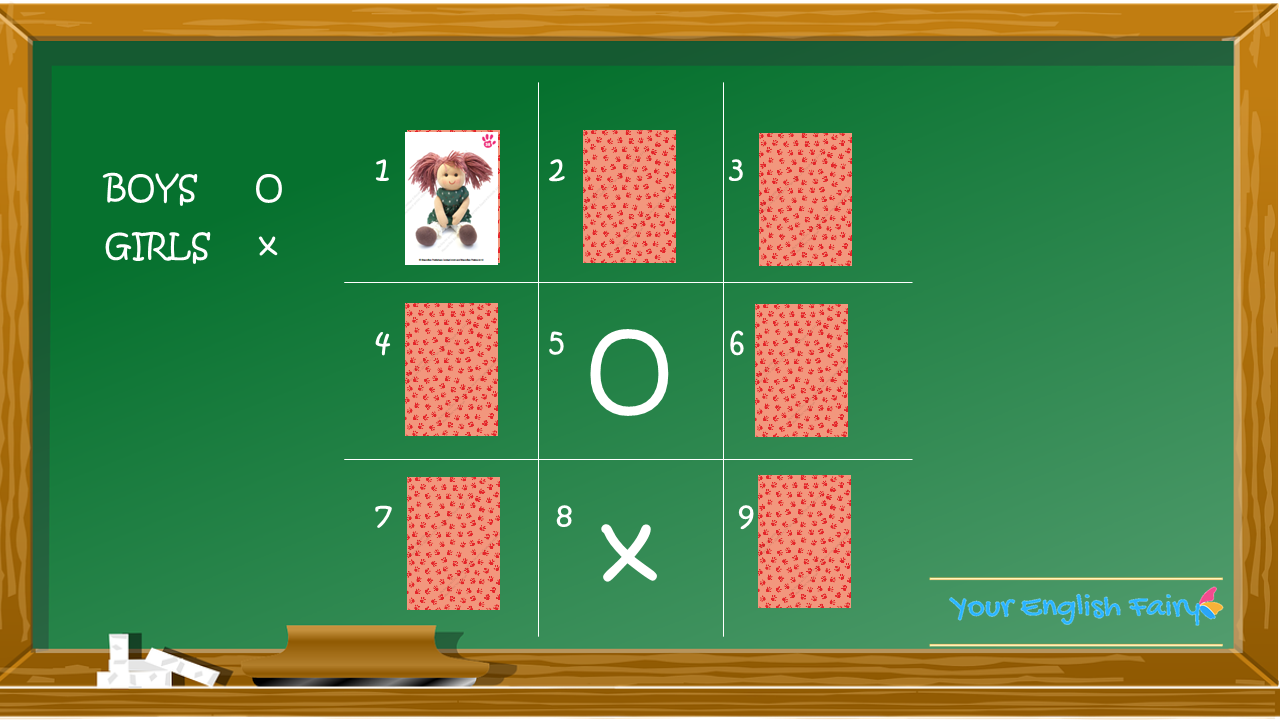
GAME No 4 - TIC TAC TOE
You know it as a paper-and-pencil game but I use my blackboard and flashcards to play it. I divide a class into two groups, usually girls and boys (X and O). I put nine flashcards on the board (face down) and number the spaces. In order to mark a space with their symbol, the students have to choose a space and say its number in English. Then I turn the card from the chosen space over and they have to name the picture in English. If they do it correctly, I remove the card and draw their symbol in the space. The first team to place three of their marks in a horizontal, vertical, or diagonal row wins the game.
GAME No 3 - PICTURE GO!
This game doesn't require a blackboard. It requires some space. What do you need to do? Give each student a check list with words and ask them to write the numbers in the boxes in a random order. Hang the matching flashcards around the classroom. Then tell the students to go quietly eg. to number 5. They have to find the number on their list, quietly read the word and go to the card that matches the word. In this way there will be groups of students standing under each flashcard. Ask one student from each group to name the picture on the card in English. Then tell them to go to another number.
GAME No 2 - DISSAPEARING CATS
This activity is taken from
"Oxford Basics for Children - Starting and Ending Lessons". I draw two cats on the board (or any other creatures or things). One cat belongs to my students, one belongs to me. I usually revise six words with my students, showing them flashcards. Then I shuffle the flashcards and pick one without children to see it. They have to guess which picture I have chosen. If they are correct, I rub out a part of my cat. If they are wrong, I rub out part of their cat. I make the rubbing part very dramatic, eg. "
Oh no! My cat lost his eye! He's a pirate now." It usually makes children laugh. They are also very happy, when my cat dissapears first.
GAME No 1 - THE FLY
It's definitely my favourite flashcard game! It's an activity for the whole class or for pairs/small groups. At the beginning, I write directions on the board (up, down, left, right). If we play it for the first time, I have to pre-teach them the words. Then I pin a flashcard with a fly on the board and eight flashcards around it. I choose one of the students to give directions for the fly, eg. "The fly is going up. The fly is going left. The fly is going left.". When they finish, they ask the question: "Where is the fly?" and choose another student to answer it. If the answer is correct, the next student guides the fly.
* BONUS GAME - PICTURE MATHS
When I revise vocabulary with young learners, I often use basic arithmetic operations (such as adding, subtracting, multiplying, and dividing numbers). I pre-teach words like: plus, minus, times and divided by. I put 6 flashcards on the board and I number them 1-6. Then I ask, e.g. "What is 2 + 2?". My students calculate it quietly and instead of saying the right number they have to tell me what is in the picture. So their answer is "mouse" not "4".
What are your favourite flashcard games? Can you share them in the commnets? Do you like my ideas?